Apologetics
Earth in the Balance, Part 2
Pastor Kent looks at hurricane season through Genesis 6 — God's covenant with Noah that the seasons would keep a steady, predictable rhythm. Even storms, it turns out, serve a purpose.
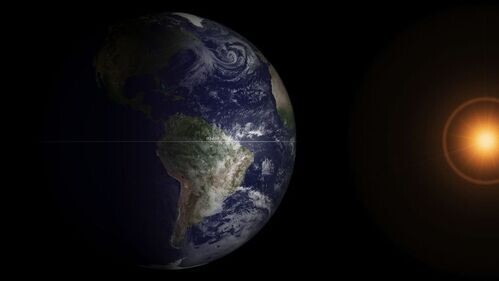
[Note: Six months ago, at the time of the vernal equinox, I posted Earth in the Balance describing how life on earth is calibrated with incredible precision to support human life: https://christchurchmiami.org/blog/2026/03/14/earth-in-the-balance. This is a continuation of that line of thought.]
*********
Before I begin this blog – has anybody seen my summer? It was here just a few minutes ago. I looked away for just a few minutes and it was gone. Anybody?
Whatever happened, I have it on reliable authority that this Monday, September 22, 2025, at 2:19 PM summer ends when the autumnal equinox takes place, ushering in the season known as fall. Fall is when most of the rest of the country looks forward to cooler temps, changing leaves and football season. In South Florida we look forward to … football, and the end of hurricane season.
Trying to reason with hurricane season*
As I write this it is just past the peak of hurricane season. While South Florida has been spared so far this year, our up-and-across-the-peninsula neighbors in the Big Bend region are still recovering from the devastation caused last year by Hurricanes Debby, Helene and Milton. Their recovery will still take many more months at least, probably more like years.
Debby, Helene and Milton were like a bad dance partner who comes in uninvited, steps all over your toes, gets sloppy drunk, makes a huge mess all over the place and then leaves you there to clean up after her and pay for it all. There is a name for nasty, ill-mannered creatures like Debby, Helene and Milton.
I was going for “natural disaster.” What were you thinking?
I don’t like hurricanes. I don’t like seeing news reporters lashing themselves to palm trees as they tell us, “Whatever you do, DO NOT GET OUT IN THIS OR YOU WILL DIE*!!!!!*” I really don’t like being without electricity and Internet access and the ability to watch the news. (First-world problems, I know.) But hey, what if one of those reporters gets blown away, and I miss it?
As someone who has lived through many of these beasts, including Hurricane Andrew – it’s part of living in South Florida – you would expect I have nothing good to say about hurricanes. But believe it or not, hurricanes do serve a useful function.
Really.
What possible purpose could hurricanes serve other than to destroy property and devastate lives?
As I understand it, they actually help regulate global temperatures. They do it by absorbing heat from north Africa, transferring it across the Atlantic in the form of tropical waves, depressions, storms and hurricanes, and depositing that heat somewhere in the western hemisphere.
Speaking for myself and approximately 99.44 percent of all Floridians, Africa can just keep all its #!*@*#! heat to itself, thank you. We’ve got all the heat and humidity we need. But that is the function hurricanes serve for the planet. That, and to help “regulate” (read: raise) insurance rates.
Oh, and sending news reporters rushing to the nearest palm tree.
A very finely tuned universe
Last year I had the privilege of telling our Kendall Christian School kids the story of Noah. Yes, that Noah, the one who built the big boat and loaded up all the animals to ride out a storm that makes Florence look like a passing shower. If you don’t want to believe that happened, fine. But if you have any room in your worldview for the supernatural and miraculous, Noah’s ark should fit in it without too much trouble. We’ve just experienced what one day of heavy downpours can do to an area; imagine what 40 days of nonstop rain would do.
Among other fascinating aspects of Noah’s story (which you can read about in Genesis 6-10), God makes a covenant with Noah when the flood is over. For his part God promises among other things never to destroy the world by flood again, something the people of the Big Bend area may have questioned for a couple days. He also promises the world will always run according to regular, predictable patterns. Night will follow day and in turn give way to day to be followed by night etc. etc. Seasons will move along in predictable order. Spring will lead to summer, summer will give birth to hurricane season which peaks September 9-10 and gradually give way to fall which will ….
Begin this Saturday at 2:50 AM. Like clockwork. God promised, and as far as I know that promise has not been rescinded.
No guesswork in the clockwork
A lifetime ago I used to play acoustic guitar a bit and lead music for various groups. A song I loved to play is Michael Martin Murphey’s Carolina in the Pines. On the off chance you’re not familiar with Michael Martin Murphey (Wildfire; What’s Forever For? Still Taking Chances) you can easily look him up. Here is the middle verse of Carolina in the Pines:
I know it may be hard for our friends in the Big Bend region to accept right now, but the earth is working according to a divinely ordained pattern. We may not understand it, and we sure don’t have to like it, but it is good to know we don’t live on an abandoned planet hurtling aimlessly through space, but on an ordained one where even hurricanes serve some higher purpose. Just as we do.
Happy fall, everyone. Right on time.
And good riddance. Debby, Helene and Milton. Don’t let the door hit ya …
Kent
*Hat tip to the late Jimmy Buffet for that line. FWIW, my son Andrew and I met Jimmy once as we were leaving a Miami Heat game. He couldn’t have been nicer.
Frequently asked questions
Do hurricanes serve any useful purpose?
What did God promise Noah after the flood?
How does the regularity of the seasons point to a Creator?
Pastoral writing from the team at Christchurch Miami — a faith family on mission in Kendall, Miami.