



History
Earth in the Balance
Stephen Hawking called it the Anthropic Principle: however you look at it, the universe seems designed for human life. From the tilt of the earth to your DNA, here's the evidence he laid out.
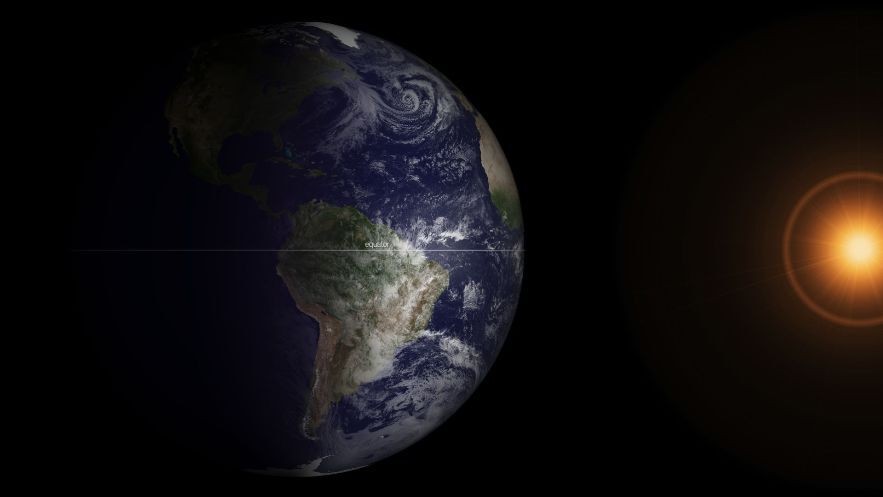
I started working on this blog originally in advance of the vernal equinox in 2018 (this year, 2026, it occurs Friday, March 20, at 10:46 AM) when I learned of the death of Stephen Hawking. Dr. Hawking, on the unlikely chance you aren’t familiar with him, was widely considered the most brilliant theoretical physicist since Albert Einstein – even including Sheldon Cooper.
Stephen Hawking’s contributions
I was a fan of Dr. Hawking. He did not share my belief in God, or at least not God as he is presented in the Bible; Hawking made a number of different statements about his theological beliefs, or lack thereof, over the years, and his final words on that subject indicated he was an atheist. Yet I admired his genius, and his ability to communicate deep scientific concepts in ways even a scientific layman (like me) could understand.
Most of all, though, I, like millions of others, admired him for his tremendous courage in continuing to contribute to our understanding of time, space, gravity and the beginnings of the universe even after he was diagnosed with a form of ALS at the age of 21.
(For an incredible portrayal of his life, do yourself a huge favor and watch the 2014 film The Theory of Everything. I was absolutely blown away by Eddie Redmayne’s transformation as Hawking, for which he, Redmayne, very deservedly won the Oscar.)
A very finely tuned universe
So here’s what I wanted to say about the vernal equinox, how we know with certainty when it will arrive each year, how it demonstrates the incredibly fine-tuned precision of our planet and how the earth is designed (loaded word, that) to support human life. And in making my case I call as my expert witness – Stephen Hawking.
In his 1988 book A Brief History of Time Hawking used the term Anthropic Principle. Simply stated, it just means that however you look at it, the universe certainly seems designed to support human life. Consider this:
-
The earth tilts at an angle of 23 degrees in relationship to the sun. If you changed that angle even slightly in either direction, the resulting changes in temperature would be so extreme that life as we know it could not exist.
-
If the moon were 50,000 miles away from the earth instead of 200,000 miles, the ocean tides would be so enormous that all the continents would be submerged, and even the mountains would erode.
-
If the ratio of carbon to oxygen in the atmosphere was slightly different, none of us would be around to breathe it.
There are many other examples:
- the position of the earth (in terms of distance) in relation to the sun;
- the precise strength of the force of gravity;
- the exact balance between the positive and negative charges in the electron;
– all have to be just rightfor life to happen. Even more mind-boggling, consider this from Dr. Hawking:
“We all understand now that the universe is still expanding, and apparently the rate of its expansion is a very critical factor in understanding how the universe came into being.
“… If the rate of expansion one second after the Big Bang had been smaller by even one part in a hundred thousand million million [that’s one over 100,000,000,000,000,000 – one with 17 zeroes after it] the universe would have re-collapsed before it ever reached its present size.
“ … Why is the universe so uniform on such a large scale? Why does it look the same at all points of space and in all directions? … This is like giving an exam to a number of students. If they all give exactly the same answers, you can be pretty sure they have communicated with each other.”
From the infinite to the infinitesimal
What’s true on the infinite level is also true on the infinitesimal. Consider the DNA molecule – a twisted strand of chemicals that functions in every cell of your body like a coded message. DNA is the HQ of every cell in your body. It tells every cell what to do.
Every DNA molecule contains as much information as an average library. And every DNA molecule in your body contains the same, unique message – what makes you uniquely you, unlike anyone else in the universe. Even identical twins have different DNA. That’s why DNA testing is such compelling evidence in the courtroom (usually).
Bill Gates: “DNA is like a computer program, but far, far more advanced than any software we’ve ever created.”
Your DNA sends exactly the same message to every cell in your body. How does it do it? How does a chemical compound send a message at all, much less the exact same message billions of times to very different cells?
Dr. Hawking again: “This is like giving an exam to a number of students. If they all give exactly the same answers, you can be pretty sure they have communicated with each other.”
Earth in the balance
How do galaxies and DNA molecules communicate with other galaxies and DNA molecules? My answer: We live on a very fine-tuned planet in a very fine-tuned universe that is designed – there’s that word again – to support human life.
So with all due respect to the late Dr. Hawking, he may have considered the idea that God created the universe “unconvincing.” I submit it is unavoidable … and marvelous.
Psalm 8:3-5: When I consider your heavens, the work of your fingers,
The moon and the stars, which you have ordained;
What is man that you take thought of him,
And the son of man that you care for him?
Yet you have made him a little lower than God,
And you crown him with glory and majesty!
Happy spring, everyone.
Kent
I’m indebted to numerous sources, including the following:
Stephen Hawking, A Brief History of Time
Nancy Pearcey and Charles Thaxton, The Soul of ScienceCharles W. Petit, “The gods must be crazy,” U.S. News & World Report(9-8-03)
Charles Thaxton, The Mystery of Life’s Origin
Frequently asked questions
What is the Anthropic Principle and does it point to God?
What are some examples of fine-tuning in the universe?
Why is DNA evidence of design?
What does Psalm 8 say about humanity's place in the universe?
Pastoral writing from the team at Christchurch Miami — a faith family on mission in Kendall, Miami.